
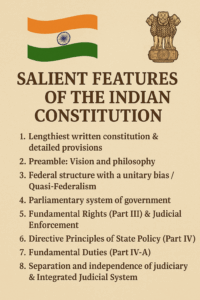
The Constitution of India, adopted on 26 November 1949 and enforced from 26 January 1950, is the supreme law of the land. Drafted with remarkable foresight, it combines the ideals of justice, liberty, equality, and fraternity with a pragmatic framework for governance. It remains the lengthiest written constitution in the world and continues to evolve through amendments and judicial interpretation.
1. Lengthiest Written Constitution
With 395 articles at inception (now over 448), 25 parts, and 12 schedules, the Indian Constitution is exhaustive. It addresses federal relations, rights, duties, governance, and special provisions for a diverse society. Its detail was necessary to accommodate India’s pluralism.
2. Preamble as the Guiding Light
The Preamble proclaims India as a Sovereign, Socialist, Secular, Democratic Republic. It embodies aspirations of justice, liberty, equality, and fraternity. In Kesavananda Bharati v. State of Kerala (1973), the Supreme Court held the Preamble forms part of the Constitution and reflects its basic structure.
3. Federalism with a Unitary Bias
India follows a unique quasi-federal model. While powers are divided between Union and States (Seventh Schedule), Articles 352, 356, and 360 allow the Centre to assume stronger control during emergencies. This ensures unity while respecting diversity.
4. Parliamentary System of Government
Borrowed from the British model, India has a parliamentary democracy. The President is the nominal executive, while the Prime Minister and Council of Ministers exercise real power. Article 75 establishes collective responsibility to the Lok Sabha.
5. Fundamental Rights (Part III)
Articles 14–32 guarantee core freedoms, including equality (Arts. 14–18), freedoms of speech and association (Art. 19), and right to life (Art. 21). In Maneka Gandhi v. Union of India (1978), the Court expanded Article 21 to mean “just, fair, and reasonable” law, broadening protection for citizens.
6. Directive Principles of State Policy (Part IV)
DPSPs (Arts. 36–51) guide governance toward social and economic justice. Though non-justiciable, they influence policy. In Minerva Mills v. Union of India (1980), the Court stressed a balance between Fundamental Rights and DPSPs as part of the basic structure.
7. Fundamental Duties (Part IV-A)
Added by the 42nd Amendment (1976) and expanded by the 86th Amendment, citizens now have 11 duties, including promoting harmony and safeguarding public property. These foster a culture of responsibility.
8. Independent and Integrated Judiciary
India’s judiciary is independent (secured by Articles 124–147, 214–237) and integrated (a single system topped by the Supreme Court). Judicial review under Articles 32 and 226 empowers courts to strike down unconstitutional laws.
9. Doctrine of Basic Structure
The landmark Kesavananda Bharati case established that while Parliament can amend the Constitution (Art. 368), it cannot alter its basic structure—democracy, rule of law, judicial review, and secularism.
10. Blend of Rigidity and Flexibility
Certain provisions can be amended by a simple majority, while federal features require ratification by half the states (Art. 368). This balance ensures adaptability without compromising core principles.
11. Universal Adult Franchise and Free Elections
Articles 325–326 guarantee universal suffrage. In Indira Nehru Gandhi v. Raj Narain (1975), the Court ruled that free and fair elections form part of the Constitution’s basic structure.
12. Single Citizenship
Unlike federations such as the USA, India grants single citizenship. Citizens enjoy equal rights and duties across the nation, strengthening unity.
13. Secularism and Social Justice
Articles 25–28 guarantee freedom of religion while ensuring the state remains neutral. Affirmative action under Articles 15(4) and 16(4) promotes social justice. The Constitution envisions a welfare state.
14. Emergency Provisions
Articles 352, 356, and 360 empower the Centre to declare emergencies—national, state, or financial. While necessary for stability, misuse has sparked debate, notably during the 1975 Emergency.
Conclusion
The Indian Constitution is both a legal and moral charter, designed to uphold unity while safeguarding rights. Through doctrines like basic structure and judicial innovation, it adapts to changing times without losing its core essence. It remains not just a document of governance but a living testament to India’s democratic journey.